By pteexamprep editorial teamPublished 9 Oct 2026Updated 10 Oct 2026Reviewed 10 Oct 2026 against official sources
PTE stands for Pearson Test of English — a Pearson-owned family of computer-based English tests. When people say "PTE exam" without qualifying it, they usually mean PTE Academic: a roughly 2-hour test of reading, writing, listening and speaking, scored from 10 to 90, used for university admissions worldwide and for Australian and New Zealand visas. Since 7 August 2025 it has 22 scored question types. Related tests — PTE Academic UKVI, PTE Core and PTE Home — cover UK visas, Canadian immigration and UK family/settlement routes respectively.
Which PTE test do you need?
| You're applying for… | Book this test |
|---|---|
| University or college admission (most countries) | PTE Academic |
| Australia or New Zealand visa | PTE Academic |
| UK work visa or study below degree level (Secure English Language Test) | PTE Academic UKVI |
| UK family or settlement route (speaking & listening only) | PTE Home (A1/A2/B1) |
| Canada: IRCC permanent residency or citizenship | PTE Core |
These aren't interchangeable — a government or university that names a specific test won't accept a different one. See the full breakdown, including format differences, in PTE Academic vs Core vs UKVI.
PTE exam eligibility
Pearson's eligibility requirement is narrower than most guides suggest:
- No minimum or maximum age found on Pearson's pages. The identification policy mentions a still-valid child passport (under 18), but we found no explicit age rule, so confirm with Pearson support if you are a minor. The "18+" claim common elsewhere is not something we could verify.
- No education prerequisite found. Your university or visa may set one, but we found no qualification requirement to book the test itself.
- Valid passport expected. It must be the ID you select when booking, issued no more than 10 years ago, not expired, with name, date of birth, citizenship and gender matching your booking exactly, and a photo that matches how you look now. If you test outside your country of citizenship, a passport is the only accepted ID; inside it, Pearson keeps an exceptions list of alternative IDs, so check that list before relying on one.
- No separate English-proficiency gate. You don't need to prove an existing English level to register; the test itself measures it.
So the practical eligibility bar is simply: have a valid, correctly detailed passport and a seat available near you.
PTE exam pattern at a glance
| Part | Duration | Question types |
|---|---|---|
| Speaking & Writing | 76–84 minutes | 9 |
| Reading | 23–30 minutes | 5 |
| Listening | 31–39 minutes | 8 |
That's 22 scored question types in total, including two speaking tasks added in August 2025: Summarize Group Discussion and Respond to a Situation.
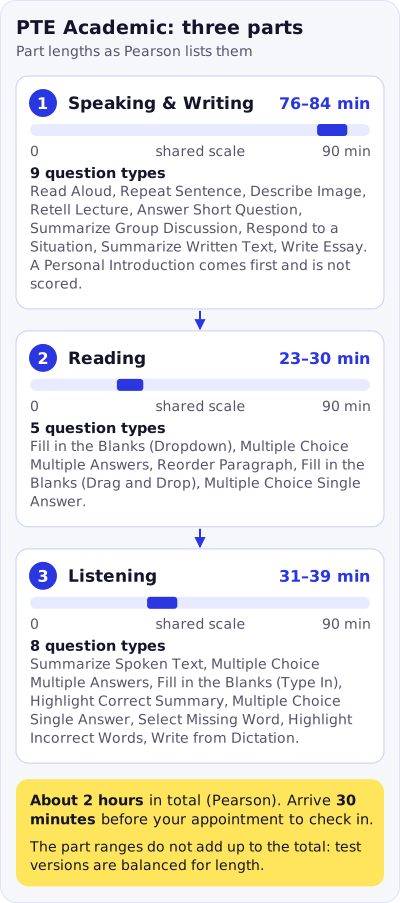
Text version of this diagram
- Part 1, Speaking & Writing: 76–84 minutes, 9 question types (a Personal Introduction comes first and is not scored).
- Part 2, Reading: 23–30 minutes, 5 question types.
- Part 3, Listening: 31–39 minutes, 8 question types.
- Pearson says the test takes about two hours; arrive 30 minutes before your appointment to check in. The part ranges do not add up to the total because test versions are balanced for length.
For the full task-by-task timing and what each one tests, see PTE exam pattern and what changed in the 2025 update.
PTE exam dates: there's no fixed calendar
A lot of search results imply PTE has scheduled sitting dates, like IELTS does. It doesn't. Pearson offers PTE Academic through test centres in over 115 countries and advertises frequent test dates. In practice you pick a date and time slot that is free near you on the booking page rather than waiting for a fixed exam date. Availability varies by city.
How to book the PTE exam
- Create a Pearson (myPTE) account and decide which test you need from the table above.
- Search available slots at your nearest centre — availability varies by city and test type.
- Pay the test fee and complete registration using the exact passport details you'll bring on test day.
- Receive your booking confirmation and prepare using the PTE exam pattern as your checklist.
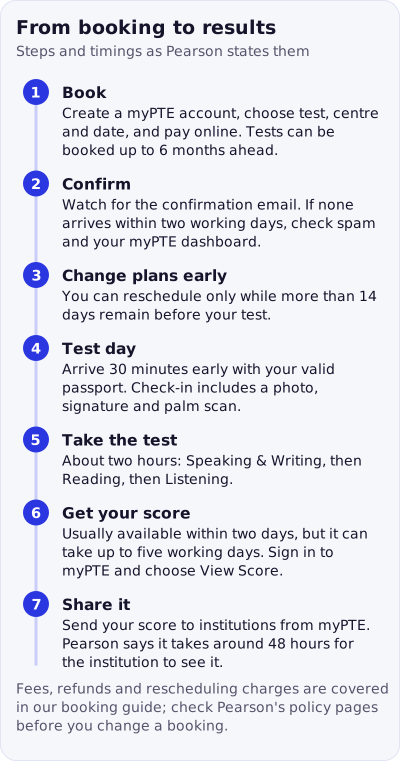
Text version of this diagram
- 1. Book: create a myPTE account, choose test, centre and date, and pay online. Tests can be booked up to 6 months ahead.
- 2. Confirm: if no confirmation email arrives within two working days, check spam and your myPTE dashboard.
- 3. Change plans early: you can reschedule only while more than 14 days remain before your test.
- 4. Test day: arrive 30 minutes early with your valid passport; check-in includes a photo, signature and palm scan.
- 5. Take the test: about two hours.
- 6. Get your score: usually within two days, up to five working days; sign in to myPTE and choose View Score.
- 7. Share it: send your score from myPTE; it takes around 48 hours for the institution to see it.
The step-by-step version, with slot and rescheduling details, is in how to book the PTE exam.
PTE exam duration
PTE Academic is about 2 hours long, taken on a computer at an authorised test centre (not at home). PTE Core and PTE Home use different formats; for example, PTE Core replaces the essay with a Write Email task. See PTE Academic vs Core vs UKVI for the exact section-by-section comparison.
PTE exam fee
Pearson sets the fee per country and test type, and it changes periodically. Rather than quoting a number that goes stale, check the current fee for your test and location on PTE exam fee.
PTE result and score validity
- Turnaround: Pearson says PTE Academic results are typically ready within 48 hours, and up to five business days in some cases.
- Validity: a PTE Academic score is valid for 2 years from your test date.
- University minimum scores: institutions set their own bar, but Pearson's own scoring guidance gives typical ranges — foundation courses around 36–50, undergraduate degrees around 51–60, and postgraduate degrees around 57–67 overall. Always confirm with the specific institution.
- Once your result is out, use the PTE score chart to read every band, or the PTE to IELTS converter if a requirement is written in IELTS bands. For the full breakdown of what "good" means, see PTE passing score.
Learn more about receiving and sharing your result on PTE result.
Where PTE is accepted
PTE Academic is accepted by 4,000+ universities and colleges, by the Australian and New Zealand governments for migration visas, and by US nursing registration bodies. See the country-by-country breakdown on PTE accepted countries, or go straight to your destination:
- PTE score for Australia
- PTE score for Canada (PTE Core, not PTE Academic)
- PTE score for UK
- PTE score for New Zealand
Finding a test centre
Pearson runs PTE at authorised test centres in over 115 countries. In India, see PTE exam centres in India for city-wise options.
How to prepare
Start with a realistic practice plan rather than guessing which tasks matter most:
- PTE preparation guide: a structured study plan by skill and timeline
- PTE mock test: a full-length practice run under real timing
- Practice hub: every PTE Academic question type, with original items and instant feedback
- PTE collocations list: useful word pairs for Speaking and Writing tasks
- PTE score calculator: estimate your overall score
All practice questions on this site are written from scratch for study purposes — never copies of real or "leaked" exam content.
Related reading
Frequently asked questions
What is the full form of PTE?
PTE stands for Pearson Test of English, a family of computer-based English tests owned by Pearson. The main one most people mean by "PTE" is PTE Academic, used for university admissions and for Australian and New Zealand visas.
What is the PTE exam used for?
PTE Academic is used to prove English proficiency for university and college admissions worldwide and for Australian and New Zealand visa applications. PTE Academic UKVI is used for UK visas, and PTE Core is used for Canadian permanent residency and citizenship applications through IRCC. Two-skill PTE Home tests cover some UK family, extension and citizenship routes.
Is there an age limit for the PTE exam?
The Pearson pages we checked do not state a minimum or maximum age, so the "18+" figure repeated on many sites is not an official rule we could verify. Its identification policy does mention a still-valid child passport (under 18) as test-day ID. Confirm any age rule with Pearson support and with your university or visa authority before booking. What Pearson clearly enforces is ID that matches your booking details.
What ID do I need to take the PTE exam?
For all PTE tests Pearson asks for a valid passport: not expired, issued no more than 10 years ago, and matching the name, date of birth, citizenship and gender you used when booking. It must be the physical document (digital copies and photocopies are rejected) and the photo must match your current appearance. Without acceptable ID you can be refused entry and lose your fee.
Are there fixed PTE exam dates in 2026?
No. Unlike IELTS, PTE doesn't run on fixed sitting dates. Pearson describes frequent test dates and has test centres in over 115 countries, so you pick from the available slots near you on its booking page.
How long does it take to get PTE exam results?
Pearson says PTE Academic results are typically ready within 48 hours. Most test takers get them within two business days, but Pearson notes it can take up to five business days depending on processing.
How long is a PTE score valid?
A PTE Academic score is valid for two years from the test date, after which it expires. Some institutions set a different expiry date, so check yours.
PTE exam kya hota hai?
PTE (Pearson Test of English) is a computer-based English test that checks your reading, writing, listening and speaking skills using AI scoring, with some responses also checked by a human reviewer. It's used for university admissions and for study, work or migration visas.
Is the PTE exam hard?
Difficulty depends on your English level and familiarity with the task types, not on the test being inherently harder than alternatives like IELTS. The most useful preparation is practising each of the 22 question types under real timing; this site's [practice hub](/practice) has original practice items for them.
Official sources
- pearsonpte.com/pte-academic/ (checked 2026-10-09)
- pearsonpte.com/pte-academic/scoring/ (checked 2026-10-09)
- pearsonpte.com/policy-center/identification-policy/ (checked 2026-10-09)
- pearsonpte.com/pte-updates-2025/ (checked 2026-10-09)
- pearsonpte.com/pte-academic/test-format/ (checked 2026-10-10)
- pearsonpte.com/on-test-day/ (checked 2026-10-10)
- pearsonpte.com/pte-academic/score-guide (checked 2026-10-10)
- pearsonpte.com/help-center/booking-managing-test/ (checked 2026-10-10)
- pearsonpte.com/policy-center/retake-policy/ (checked 2026-10-10)
- pearsonpte.com/help-center/scoring/ (checked 2026-10-10)