By pteexamprep editorial teamPublished 9 Oct 2026Updated 10 Oct 2026Reviewed 10 Oct 2026 against official sources
PTE Academic in 2026 has three parts - Speaking & Writing, Reading, Listening - run back-to-back in one sitting of about 2 hours, with 22 scored question types across them. The format hasn't changed since 7 August 2025, when Pearson added two speaking tasks (Summarize Group Discussion and Respond to a Situation). Scores for the overall test and for each of the four skills are reported from 10 to 90, and Pearson says results typically arrive within 48 hours, though its Help Centre notes they can take up to five working days.
PTE exam pattern at a glance
| Part | Duration | Question types |
|---|---|---|
| Part 1: Speaking & Writing | 76-84 minutes | 9 (+ 1 unscored Personal Introduction) |
| Part 2: Reading | 23-30 minutes | 5 |
| Part 3: Listening | 31-39 minutes | 8 |
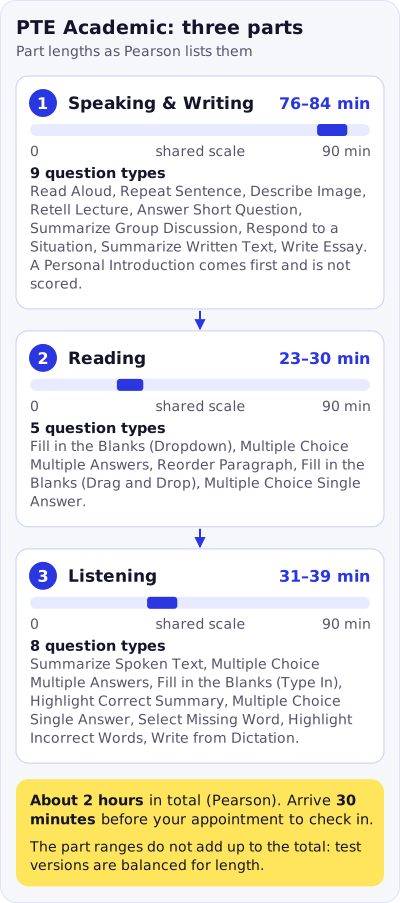
Pearson gives each part as a time range and says to allow two hours in total; it does not publish how many items of each type any given candidate will get, so treat any "X questions per task" figure you see elsewhere as an estimate, not a fact.
Text version of this diagram
- Part 1, Speaking & Writing: 76–84 minutes, 9 question types (a Personal Introduction comes first and is not scored).
- Part 2, Reading: 23–30 minutes, 5 question types.
- Part 3, Listening: 31–39 minutes, 8 question types.
- Pearson says the test takes about two hours; arrive 30 minutes before your appointment to check in. The part ranges do not add up to the total because test versions are balanced for length.
PTE exam flow: the order of events on test day
- Arrive at least 30 minutes early. You check in with a valid passport; staff verify your ID, take a photo, signature and palm scan, and ask you to store all personal items in a locker.
- You're seated in a partitioned booth with a computer, headset, keyboard, and a notepad and pencil for taking notes.
- Personal Introduction (not scored). 25 seconds to read a prompt, then 30 seconds to record yourself answering it. This just familiarises you with the recording interface - it is not used in your score.
- Part 1: Speaking & Writing runs first, speaking tasks before the two writing tasks.
- Part 2: Reading runs next.
- Part 3: Listening runs last.
- You finish and leave - Pearson's scores page says score reports typically arrive within 48 hours, and its Help Centre says results usually take two days but can take up to five working days. You are emailed when the score is ready, and it appears in your myPTE account.
Pearson's official test-day guide describes this as one continuous session and does not mention a scheduled break anywhere in it, so plan to get through all three parts without a planned pause. Within the speaking tasks you get only one recording attempt, and listening clips play only once.
Part 1: Speaking & Writing (76-84 minutes)
| Question type | Preparation | Response time | What you see or hear |
|---|---|---|---|
| Personal Introduction (not scored) | 25 sec | 30 sec | - |
| Read Aloud | 30-40 sec | Varies with text length | Text up to 60 words |
| Repeat Sentence | - | 15 sec | Audio 3-9 sec |
| Describe Image | 25 sec | 40 sec | Graph, chart, map, picture |
| Retell Lecture | 10 sec | 40 sec | Audio up to 90 sec |
| Answer Short Question | - | 10 sec | Audio 3-9 sec |
| Summarize Group Discussion (added Aug 2025) | 10 sec | 2 min | 3-speaker discussion up to 3 min |
| Respond to a Situation (added Aug 2025) | 10 sec | 40 sec | Situation up to 60 words (read and heard) |
| Summarize Written Text | - | 10 min | Text up to 300 words; write one sentence, up to 75 words |
| Write Essay | - | 20 min | Write 200-300 words |
In the speaking tasks you get only one recording attempt. The microphone opens after a short tone in most tasks; in Answer Short Question there is no tone, so start answering the moment the audio ends. If you pause for about three seconds the recording stops, so keep talking.
Part 2: Reading (23-30 minutes)
| Question type | Text length | Skills scored |
|---|---|---|
| Reading & Writing: Fill in the Blanks | Up to 200 words | Reading and Writing |
| Multiple Choice, Multiple Answers | Up to 350 words | Reading |
| Re-order Paragraphs | Up to 110 words | Reading |
| Reading: Fill in the Blanks | Up to 80 words | Reading |
| Multiple Choice, Single Answer | Up to 110 words | Reading |
Reading has no per-question timer; the 23-30 minute figure is for the whole part.
- Reading & Writing: Fill in the Blanks. Pick the right word from a dropdown for each gap in a passage up to 200 words. Also counts towards your Writing score.
- Multiple Choice, Multiple Answers. Select every correct option based on the passage. Pearson says you score marks for correct options but lose points for incorrect ones, so avoid guessing.
- Re-order Paragraphs. Drag jumbled text boxes into the correct order.
- Reading: Fill in the Blanks. Drag words from a box into gaps in the passage.
- Multiple Choice, Single Answer. Pick one correct response.
Part 3: Listening (31-39 minutes)
Each audio or video clip plays automatically and only once; you're allowed to take notes throughout.
| Question type | Recording length | Skills scored |
|---|---|---|
| Summarize Spoken Text | 60-90 sec | Listening and Writing |
| Multiple Choice, Multiple Answers | 80-120 sec | Listening |
| Fill in the Blanks (Type In) | 30-60 sec | Listening and Writing |
| Highlight Correct Summary | 30-90 sec | Listening and Reading |
| Multiple Choice, Single Answer | 30-60 sec | Listening |
| Select Missing Word | 20-70 sec | Listening |
| Highlight Incorrect Words | 15-50 sec | Listening and Reading |
| Write From Dictation | 3-5 sec | Listening and Writing |
- Summarize Spoken Text. After a 60-90 second recording, write a 50-70 word summary (10 minutes total).
- Multiple Choice, Multiple Answers.
- Fill in the Blanks (Type In). Type the missing words as you listen.
- Highlight Correct Summary. Pick the summary that best matches what you heard.
- Multiple Choice, Single Answer.
- Select Missing Word. The recording cuts off and is replaced by a beep on the final word or phrase; choose what was said.
- Highlight Incorrect Words. A transcript appears as you listen; click the words that don't match the audio.
- Write From Dictation. Type a sentence exactly as you hear it.
Integrated scoring: why some tasks count twice
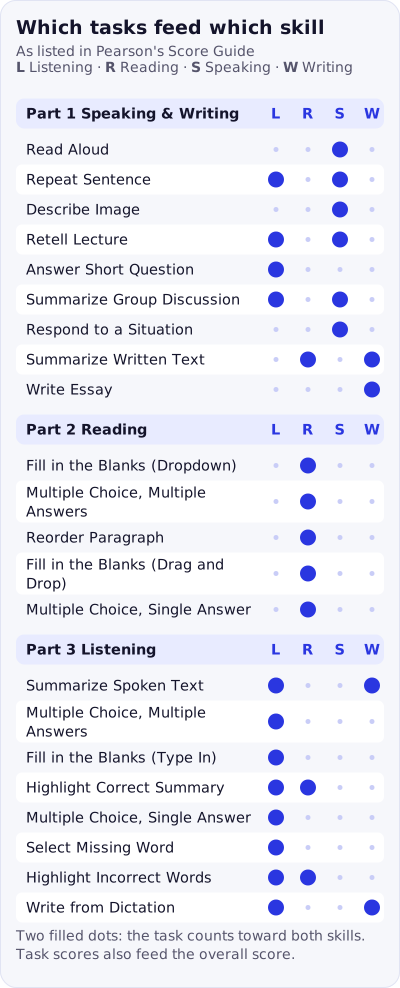
Several PTE tasks score more than one skill at once. Write From Dictation counts towards Listening and Writing; Reading & Writing: Fill in the Blanks counts towards Reading and Writing; Repeat Sentence counts towards Listening and Speaking (Pearson lists Answer Short Question as Listening only). Summarize Spoken Text counts towards Listening and Writing, and Summarize Written Text towards Reading and Writing. Because these integrated tasks feed two skills at once, they repay practice time. The map below shows which skill each of the 22 question types feeds, as listed in Pearson's Score Guide.
Text version of this diagram
- Read Aloud: Speaking
- Repeat Sentence: Listening and Speaking
- Describe Image: Speaking
- Retell Lecture: Listening and Speaking
- Answer Short Question: Listening
- Summarize Group Discussion: Listening and Speaking
- Respond to a Situation: Speaking
- Summarize Written Text: Reading and Writing
- Write Essay: Writing
- Fill in the Blanks (Dropdown): Reading
- Multiple Choice, Multiple Answers: Reading
- Reorder Paragraph: Reading
- Fill in the Blanks (Drag and Drop): Reading
- Multiple Choice, Single Answer: Reading
- Summarize Spoken Text: Listening and Writing
- Multiple Choice, Multiple Answers: Listening
- Fill in the Blanks (Type In): Listening
- Highlight Correct Summary: Listening and Reading
- Multiple Choice, Single Answer: Listening
- Select Missing Word: Listening
- Highlight Incorrect Words: Listening and Reading
- Write from Dictation: Listening and Writing
How each part is actually scored
Pearson's scoring guide breaks every task down into specific factors rather than a single "right or wrong" mark:
- Read Aloud and Repeat Sentence are judged on three factors: content, oral fluency and pronunciation.
- Describe Image, Retell Lecture and Summarize Group Discussion also use three factors (content, pronunciation, oral fluency), but content here means how accurately and fully you cover the image, lecture or discussion, including relationships and conclusions. Responses must be in your own words.
- Summarize Written Text is judged on four factors: content, form, grammar and vocabulary. A summary under 5 or over 75 words is scored zero.
- Summarize Spoken Text adds spelling, making five factors: content, form, grammar, vocabulary and spelling.
- Write Essay uses seven factors: content, development/structure/coherence, form, general linguistic range, grammar, vocabulary range and spelling. Under 120 or over 380 words scores zero; 200-300 words earns full form credit.
- Fill-in-the-blank and Re-order Paragraphs items give full marks only when every blank or box is right, and partial credit otherwise. Single-answer multiple choice is right or wrong, and Answer Short Question is correct or incorrect.
- Multiple Choice, Multiple Answers and Highlight Incorrect Words deduct points for wrong selections.
Some responses are also checked by a human expert before your final score is confirmed, on top of the automated AI scoring.
Which PTE test does this pattern apply to?
This pattern is for PTE Academic and PTE Academic UKVI - they share the same format and scoring, and UKVI is simply taken at a UKVI-approved centre for UK visa purposes. PTE Core, the test Canada uses for Express Entry and other economic immigration programs, has a shorter format with different, more everyday-English tasks. See PTE Academic vs Core vs UKVI to work out which one you actually need, and what changed in the August 2025 update if you last checked the format before then.
Printable PTE exam pattern (2026)
There's no official PTE syllabus PDF published by Pearson - the real, current format only exists on its website, split across several pages. This page already consolidates every part, timing and question type into plain tables, so the simplest reliable "PDF" is this page itself: press Ctrl+P (Windows) or Cmd+P (Mac) and save as PDF, or bookmark this page so you always see the latest version instead of a stale download that nobody updates after the next format change.
Start practising
- Summarize Group Discussion practice: the newest and longest speaking task
- Respond to a Situation practice
- Write From Dictation practice
- Not sure where to start? See our full PTE preparation plan
- Want a full timed run-through? Try a free PTE mock test
Where to go next
- Already have a target score in mind? Check what you qualify for in Australia
- Coming from IELTS, or deciding between the two? Read PTE vs IELTS or convert your IELTS band to a PTE score
- Not sure what counts as a good score? See the PTE score chart and PTE passing score guide
Related reading
- PTE Academic home and free practice
- Printable practice questions by section
- Find a PTE centre in your city
- Reading question types and timing
- PTE listening question types and timings
- PTE speaking practice with official task timings
- PTE writing test tasks and word limits
- Free PTE reading fill in the blanks practice
- Reorder paragraphs practice
- Listening fill in the blanks practice
- Highlight Incorrect Words practice
- Summarize Spoken Text practice with timed answers
- Practise Summarize Written Text with a free timer and word counter
- Write Essay practice with a timer
- Repeat Sentence practice
- Read Aloud practice with a free score estimate
- Retell Lecture practice with lectures and model answers
- Describe Image practice
- Describe Image chart types and timings
Frequently asked questions
What is the pattern of the PTE test?
PTE Academic has three parts taken back-to-back in one roughly 2-hour sitting: Part 1 Speaking & Writing (76-84 minutes, 9 question types), Part 2 Reading (23-30 minutes, 5 question types) and Part 3 Listening (31-39 minutes, 8 question types). That is 22 scored question types in total, plus an unscored Personal Introduction at the very start.
What is the sequence (flow) of the PTE exam?
After check-in you do an unscored Personal Introduction, then the three parts run in a fixed order: Speaking & Writing, then Reading, then Listening. Within Part 1, speaking tasks come before the two writing tasks (Summarize Written Text, Write Essay). Each speaking response can be recorded only once, and audio clips play only once.
How long is the PTE exam in 2026?
About 2 hours in total: 76-84 minutes for Speaking & Writing, 23-30 minutes for Reading and 31-39 minutes for Listening. Pearson's own test-day guide tells candidates to plan for two hours to complete PTE Academic, PTE Academic UKVI or PTE Core.
Is there a break during the PTE exam?
Pearson's official test-day guide does not mention a scheduled break anywhere in its description of PTE Academic, PTE Academic UKVI or PTE Core - it simply says you have two hours to complete the test. Plan to sit through all three parts in one continuous session.
Is PTE harder than IELTS, or is IELTS tougher than PTE?
Neither test is objectively harder - they assess the same four skills differently. PTE is fully computer-based with AI scoring and no human examiner for speaking, while IELTS Academic includes a face-to-face speaking interview with an examiner. See our full PTE vs IELTS comparison for a side-by-side breakdown.
What is 7.5 IELTS equal to in PTE?
Based on Pearson's July 2025 concordance research, an IELTS 7.5 overall band corresponds to a PTE Academic overall score of 71-78. Use our PTE-IELTS converter for the full skill-by-skill table, since Listening, Reading, Speaking and Writing each map to a slightly different PTE range.
Is 45 or 65 a good score in PTE?
It depends entirely on what you need it for - PTE has no universal pass mark. Pearson's own guidance gives institutions a rough band of 36-50 for foundation courses, 51-60 for undergraduate degrees and 57-67 for postgraduate degrees, but every institution sets its own minimum. Check our PTE score chart and passing-score guide for your specific course or visa.
What is the PTE Academic syllabus for 2026, and can I get a PDF?
There is no official downloadable PTE syllabus PDF from Pearson - the format lives only on its website. This page is the full, up-to-date syllabus: all 22 question types with timing, grouped by part. Use your browser's Print (Ctrl/Cmd+P) on this page to save it as a PDF for offline reference.
Official sources
- pearsonpte.com/pte-academic/test-format/ (checked 2026-10-09)
- pearsonpte.com/pte-academic/test-format/speaking-writing/ (checked 2026-10-09)
- pearsonpte.com/pte-academic/test-format/reading/ (checked 2026-10-09)
- pearsonpte.com/pte-academic/test-format/listening/ (checked 2026-10-09)
- pearsonpte.com/pte-academic/scoring/ (checked 2026-10-09)
- pearsonpte.com/on-test-day/ (checked 2026-10-09)
- pearsonpte.com/pte-updates-2025/ (checked 2026-10-09)
- pearsonpte.com/pte-academic/scores (checked 2026-10-10)
- pearsonpte.com/help-center/scoring/ (checked 2026-10-10)
- pearsonpte.com/pte-academic/score-guide (checked 2026-10-10)