By pteexamprep editorial teamPublished 9 Oct 2026Updated 10 Oct 2026Reviewed 10 Oct 2026 against official sources
PTE preparation works best when you learn the exam format first, practise each question type with a timer, and finish with full mock tests. PTE Academic has three parts taken in one sitting of about two hours. Pearson says most candidates prepare for 2 to 4 weeks. This guide gives you a study plan for 2, 4 or 8 weeks, tips for each part, and free original practice for every scored question type.
What the PTE test covers
Pearson lists the same format for PTE Academic and PTE Academic UKVI. Part 1 is Speaking and Writing, Part 2 is Reading and Part 3 is Listening.
| Part | Skills | Question types |
|---|---|---|
| Part 1 | Speaking and Writing | 9 (Pearson lists 76 to 84 minutes for this part) |
| Part 2 | Reading | 5 |
| Part 3 | Listening | 8 |
That is 22 scored question types, plus an unscored personal introduction at the start. For the full order and scoring, read our PTE exam pattern guide. For the newest speaking tasks, see what changed in the 2025 format.
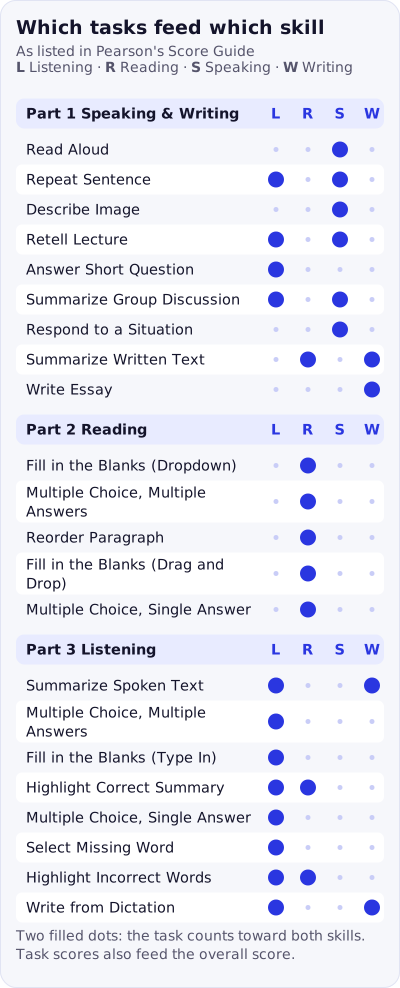
Text version of this diagram
- Read Aloud: Speaking
- Repeat Sentence: Listening and Speaking
- Describe Image: Speaking
- Retell Lecture: Listening and Speaking
- Answer Short Question: Listening
- Summarize Group Discussion: Listening and Speaking
- Respond to a Situation: Speaking
- Summarize Written Text: Reading and Writing
- Write Essay: Writing
- Fill in the Blanks (Dropdown): Reading
- Multiple Choice, Multiple Answers: Reading
- Reorder Paragraph: Reading
- Fill in the Blanks (Drag and Drop): Reading
- Multiple Choice, Single Answer: Reading
- Summarize Spoken Text: Listening and Writing
- Multiple Choice, Multiple Answers: Listening
- Fill in the Blanks (Type In): Listening
- Highlight Correct Summary: Listening and Reading
- Multiple Choice, Single Answer: Listening
- Select Missing Word: Listening
- Highlight Incorrect Words: Listening and Reading
- Write from Dictation: Listening and Writing
PTE preparation plan: 2, 4 or 8 weeks
Pick the plan that matches your starting level and deadline. Each plan ends with full mock tests, because the real test runs as one continuous sitting.
2-week plan (strong English, short deadline)
| Days | Focus | What to do |
|---|---|---|
| 1 to 2 | Format and diagnostic | Read the exam pattern, then do one full mock test to find your weak skill |
| 3 to 6 | Speaking and writing | Practise Read Aloud, Repeat Sentence, Describe Image, Re-tell Lecture, Write Essay and Summarize Written Text |
| 7 to 9 | Reading and listening | Work through the Reading and Listening hubs, starting with your weaker part |
| 10 to 12 | Mixed sets | Timed sets across all parts, then review every wrong answer |
| 13 to 14 | Mock tests | Two full timed mock tests, with a short review after each |
4-week plan (most candidates)
| Week | Focus | What to do |
|---|---|---|
| 1 | Baseline and format | Learn all 22 question types from the practice hub and do one diagnostic mock test |
| 2 | Speaking | Daily sessions on Read Aloud, Repeat Sentence, Answer Short Question, Respond to a Situation and Summarize Group Discussion, with recordings you listen back to |
| 3 | Writing and reading | Summarize Written Text, Write Essay, Reading fill in the blanks and Reorder Paragraphs |
| 4 | Listening and mocks | Listening fill in the blanks, Highlight Incorrect Words, Summarize Spoken Text and Write From Dictation, then two full mock tests |
8-week plan (starting from a lower level)
| Weeks | Focus |
|---|---|
| 1 to 2 | Build English basics: daily reading aloud, short listening drills, vocabulary for academic topics. Learn the format with the exam guide. |
| 3 to 4 | Speaking and writing task by task, with one review session per week |
| 5 to 6 | Reading and listening task by task, timing every set |
| 7 | Mixed timed sets and a full mock test at the end of the week |
| 8 | Two to three full mock tests, targeting the skills that stayed weakest |
Pearson says preparation time depends on your current English level and how much daily practice you can do, so adjust these plans to fit. If you are unsure of the test options, compare PTE Academic, Core and UKVI before you start.
PTE tips and tricks by part
Speaking and Writing
-
Read Aloud and Repeat Sentence: speak clearly and at a natural pace. For Read Aloud you can record your answer only once, so practise each sentence before you record.
-
Describe Image: use the picture to describe the main trend or point first, then add detail.
-
Re-tell Lecture: Pearson gives you 3 seconds to look at the image before the recording starts. Use it to think of the likely topic and vocabulary.
-
Write Essay and Summarize Written Text: keep to the word limit, state a clear position and one example, and check spelling and grammar before you submit.
-
Answer Short Question: start your answer as soon as the recording status changes. Pearson says that if you stay silent for more than three seconds, the recording stops and the item is marked completed. Give a short, accurate answer, because extra words earn no extra marks.
-
All speaking tasks: if the status changes to completed while you are still speaking, you cannot continue and must click Next.
Reading
- Read the question instructions first, then skim the passage for the structure.
- In Reorder Paragraphs, look for the topic sentence and the link words that connect ideas.
- In fill-in-the-blank tasks, check the grammar and the meaning of the whole sentence, not one word at a time.
Listening
- Use the note board to write key words, numbers and names.
- In dictation tasks, type the exact words you hear, including small words like "the" and "is".
- In Highlight Incorrect Words, compare what you read on screen with what you hear, not with what you expect.
Free practice for every question type
The table below links each scored question type to a practice page on this site. Each page uses original items, not real exam questions. Where a task has no separate page yet, the table points to the skill hub.
| Question type | Part | Practice page |
|---|---|---|
| Read Aloud | Speaking & Writing | Practice Read Aloud |
| Repeat Sentence | Speaking & Writing | Practice Repeat Sentence |
| Describe Image | Speaking & Writing | Practice Describe Image |
| Re-tell Lecture | Speaking & Writing | Practice Re-tell Lecture |
| Answer Short Question | Speaking & Writing | Practice Answer Short Question |
| Respond to a Situation | Speaking & Writing | Practice Respond to a Situation |
| Summarize Group Discussion | Speaking & Writing | Practice Summarize Group Discussion |
| Summarize Written Text | Speaking & Writing | Practice Summarize Written Text |
| Write Essay | Speaking & Writing | Practice Write Essay |
| Reading and writing fill in the blanks | Reading | Practice reading fill in the blanks |
| Reorder Paragraphs | Reading | Practice Reorder Paragraphs |
| Other reading tasks | Reading | Reading practice hub |
| Summarize Spoken Text | Listening | Practice Summarize Spoken Text |
| Listening fill in the blanks | Listening | Practice listening fill in the blanks |
| Highlight Incorrect Words | Listening | Practice Highlight Incorrect Words |
| Write From Dictation | Listening | Practice Write From Dictation |
| Other listening tasks | Listening | Listening practice hub |
For official material, Pearson's free Smart Prep section in a myPTE account has a study plan, four full Guided Practice Tests, sectional tests, video courses and test tip documents, and Pearson also sells a Scored Practice Test and other paid packages. Our free practice PDF and collocations list can help with vocabulary between sessions. For a sense of what your practice scores mean, use the PTE score calculator. Results from our tools are estimates only, not Pearson scores.
Common mistakes to avoid
- Practising only one skill. Your overall result depends on every part, so schedule all three.
- Skipping timed sessions. The test is timed task by task, so practise under the same time limits.
- Memorising templates. Scoring rewards answers that fit the question, so adapt any template to the prompt.
- Booking a test too early. Take a full mock test first and book only when your scores are steady.
Frequently asked questions
Answers below are based on Pearson's published guidance and the format described above. Where a claim is an estimate, the answer says so.
Related reading
Frequently asked questions
How should I prepare for PTE Academic?
Start by learning the format: PTE Academic has three parts taken in one sitting of about two hours. Then practise each of the 22 scored question types, check your weakest skill, and finish with full-length timed mock tests. Pearson's own guidance says to get familiar with the format, use official preparation materials and mock tests, and build your speaking, writing, reading and listening skills.
How long does it take to prepare for PTE?
Pearson says many candidates prepare for 2 to 4 weeks. The real time depends on your starting English level, whether you have taken a similar test before, and how many hours a day you can practise. Use the 2, 4 or 8 week plans on this page to match your situation.
Can I prepare for PTE at home without a coaching class?
Yes. The format, timings and question types are published by Pearson, so self-study is practical. You need a quiet place, a headset with a microphone for the speaking tasks, and a timer. Pearson's free Smart Prep portal (in a free myPTE account) offers a study plan, four full Guided Practice Tests, sectional tests, video courses and test tip documents, and the original practice on this site covers the question types; a coaching class is optional, not required.
How can I prepare PTE in 15 days?
A 15-day plan is possible only if your English is already strong and you focus on format and speed. Pearson's typical range is 2 to 4 weeks, so 15 days is a short sprint. Use the 2-week plan on this page, do the mock test in week one, and spend the rest on your weakest task types. No preparation method can promise a fixed score in a fixed number of days.
What is the 3 second rule in PTE?
There is no general scoring rule called the 3 second rule. Pearson's test tips contain two separate three-second points. In Answer Short Question, start answering as soon as recording begins, because more than three seconds of silence stops the recording. In Re-tell Lecture, you have 3 seconds before the recording plays to look at the image and think about the likely topic and vocabulary.
How do I get a high PTE score like 79 or more?
Pearson publishes the scoring criteria, but no official tip guarantees a particular score. Strong results come from following the format, answering every item fully, keeping speaking answers clear, and practising timed tasks. To see what a score means for other tests, use the PTE-to-IELTS converter and score calculator on this site, which show estimates only.
Is PTE harder than IELTS?
Neither test is objectively harder. They measure similar skills in different ways. PTE is fully computer-based with mostly AI scoring and has no face-to-face speaking interview. Which one suits you depends on whether you prefer typing and screen-based tasks. See our PTE vs IELTS comparison for the differences side by side.
PTE ki taiyari kaise karein? (How do I prepare for PTE?)
Study in this order: learn the three-part format, practise each question type with a timer, improve your English reading and listening daily, and finish with one or two full mock tests. A typical plan is 2 to 4 weeks, following the study plans on this page.
PTE preparation kivabe korbo? (How should I prepare for PTE?)
Begin with the official format, then practise the question types one by one. Use daily speaking practice with a recording, write short timed essays and summaries, and do full mock tests in the last week. Pearson's typical preparation time is 2 to 4 weeks.
Official sources
- pearsonpte.com/pte-academic/preparation/ (checked 2026-10-09)
- pearsonpte.com/pte-academic/test-format/ (checked 2026-10-09)
- pearsonpte.com/pte-academic/test-format/speaking-writing/ (checked 2026-10-09)
- pearsonpte.com/pte-academic/score-guide (checked 2026-10-10)